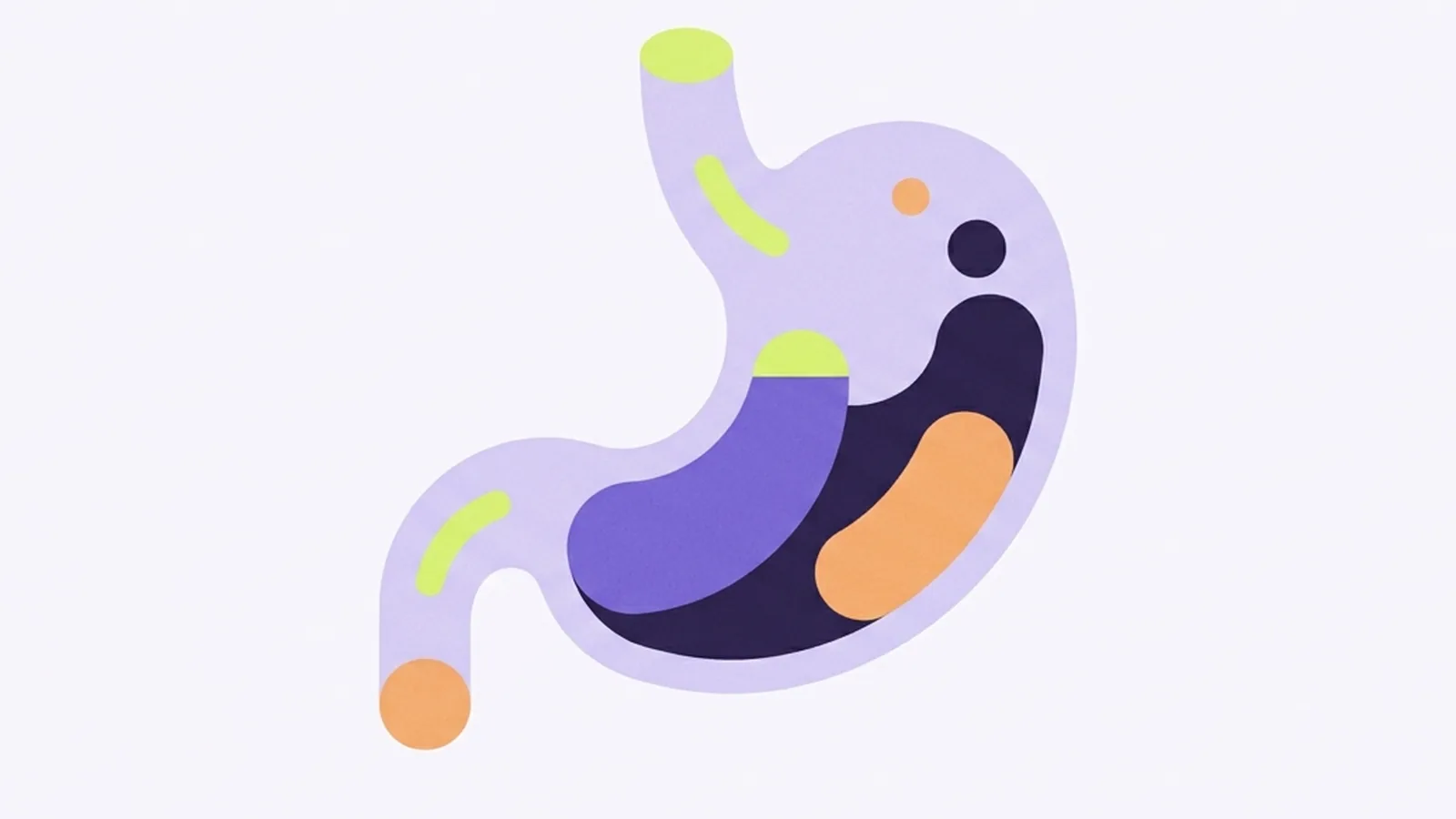
- GLP-1 medicines slow gastric emptying: in a 2024 meta-analysis of stomach scans, half a meal took about 36 minutes longer to leave the stomach than on placebo.1
- The slowing is strongest at the start and after each dose step, then partly fades with ongoing use. Scientists call this tachyphylaxis.2,5,13
- It helps explain fullness and nausea, why the labels say the medicines are not recommended in severe gastroparesis, and why your surgical team needs to know you take one.13
What is gastric emptying?
Gastric emptying is the speed at which food leaves your stomach and moves on into the small intestine. Your stomach does not empty all at once. It grinds food and lets it out in small squirts through a muscle ring at the bottom, called the pylorus. Liquids leave faster than solids. In healthy adults, most of a solid meal is gone within about 4 hours.11
A simple picture: think of the stomach as a funnel. GLP-1 medicines narrow the spout a little, so the same meal drains more slowly. The analogy stops working because the stomach is not a passive funnel. It squeezes, relaxes and responds to signals from nerves and hormones, and the medicines act on those signals, not on a valve you can see.
How do GLP-1 medicines slow the stomach?
GLP-1 is a hormone your gut releases after eating. A GLP-1 receptor agonist is a drug that switches on the same receptor as the body's own GLP-1, only much longer. Semaglutide (Wegovy, Ozempic) and tirzepatide (Zepbound, Mounjaro) are examples. Section 12.2 of each US label states plainly that the drug delays gastric emptying.13 A 2024 review notes the effect appears even at the body's normal GLP-1 levels.7 A 2011 study traced it partly to the vagus nerve, the main nerve linking brain and gut.2
How much slower? What the studies measured
The 2024 meta-analysis pooled 15 studies. In the five that used the standard stomach scan (247 people), half a meal took about 138 minutes to empty on a GLP-1 medicine vs about 95 minutes on placebo. In ten studies (411 people) that used an acetaminophen test, which mostly tracks liquids, there was no significant delay.1 So solids slow down more clearly than liquids.
Some people slow down a lot more than average. In a 12-week trial of 20 women with polycystic ovary syndrome (PCOS) and obesity, 37% of a solid meal was still in the stomach at 4 hours on semaglutide 1.0 mg, vs none on placebo. Half-emptying took 171 vs 118 minutes.6
Does the effect wear off? Tachyphylaxis
Tachyphylaxis means the body responds less to a drug as exposure continues. For stomach emptying, this is well documented:
- Within hours. In 9 healthy volunteers on a steady GLP-1 drip, emptying slowed much more after the first meal than after a second meal 4 hours later.2 In 10 healthy men, a 24-hour continuous drip slowed emptying less than short, repeated drips.3
- Over weeks. In a trial of 40 adults with obesity, liraglutide 3.0 mg (Saxenda) delayed solid emptying by a median of 70 minutes at week 5 but 30.5 minutes at week 16, vs 4 and −1 minutes on placebo.5
- Tirzepatide. The Zepbound label says the delay is largest after the first dose and diminishes over time. After a first 5 mg dose, the peak level of acetaminophen (used as a marker) fell by 55%; by week 6 at 15 mg there was no meaningful effect.13 An earlier study found a residual delay in people with type 2 diabetes after several doses.4
"Partly fades" is the right phrase, not "disappears". The PCOS study above still found a marked delay after 12 weeks.6 And a 2024 review adds that people whose stomach was already slow before treatment show little extra slowing.7
How does slow emptying link to fullness and nausea?
Food that stays in the stomach longer keeps you feeling full. In the liraglutide trial, people whose stomach slowed more at week 5 tended to lose more weight by week 16, and nausea was the most common side effect (12 of 19 on liraglutide vs 4 of 21 on placebo).5 Appetite signals in the brain matter too: the labels say the weight effects are likely mediated by appetite.13 For practical tips, see GLP-1 nausea and stomach side effects.
What the labels say about gastroparesis and severe stomach problems
Gastroparesis means "stomach paralysis": symptoms of food staying in the stomach, plus proof of slow emptying, without a blockage.8 The current US labels say (these are label instructions, not advice):13
| Label | Section | Severe stomach side effects in weight-loss trials |
|---|---|---|
| Wegovy (semaglutide) | 5.6 | 4.1% on the injection vs 0.9% on placebo; not recommended in severe gastroparesis |
| Zepbound (tirzepatide) | 5.2 | 1.7%, 2.5% and 3.1% on 5, 10 and 15 mg vs 1% on placebo; not recommended in severe gastroparesis |
| Ozempic, Mounjaro | 5.7, 5.6 | Not recommended in severe gastroparesis |
The labels also say the slower emptying may change how well other pills are absorbed (section 7.2). The Zepbound label advises people on oral birth control to switch or add a barrier method for 4 weeks after starting and after each dose increase (section 8.3).13 See GLP-1 and birth control.
Do GLP-1 medicines cause gastroparesis? The observational data
There is no randomized trial designed to answer this. The evidence comes from observational studies, which look back at health records and can show a link but not prove cause.
- US claims study (2026). Among 313,342 matched pairs of adults with type 2 diabetes, followed for a median of 5.2 months, a combined outcome of severe constipation, gastroparesis or bowel obstruction occurred at 1.02 per 100 person-years with GLP-1-based medicines vs 0.75 with SGLT2 inhibitors (hazard ratio 1.37). The risk was higher for each part, including gastroparesis. The authors stress the absolute risk was 1% or less.9
- Case reports (2026 review). A review found 12 published case reports covering 13 patients. Symptoms often began after a dose increase, and they went away in all reported patients after the medicine was stopped.10
If you have ongoing vomiting, can't keep food down or have severe belly pain, contact your care team promptly.
Why it matters before surgery or sedation
Under anesthesia, food left in the stomach could be breathed into the lungs. This is called aspiration. The labels list "pulmonary aspiration during general anesthesia or deep sedation" as a warning (Wegovy 5.10, Zepbound 5.9), based on rare reports, and tell patients to inform their providers before any planned procedure.13 Advice on whether to pause has changed since 2023. We cover it in stopping GLP-1 medicines before surgery.
What is a gastric emptying study?
A gastric emptying study, or gastric emptying scintigraphy, is the standard test for slow emptying. You eat a small low-fat meal, usually egg whites, mixed with a tiny dose of a radioactive tracer. A camera takes pictures at 0, 1, 2 and 4 hours to see how much is left.12 In 123 healthy volunteers from 11 centers, a median 1.2% of the meal remained at 4 hours, and more than 10% at 4 hours was set as the sign of delayed emptying.11 The 2022 gastroparesis guideline says diagnosis needs both symptoms and an objective test like this.8 GLP-1 medicines can affect the result, so tell the testing team you take one.
Key terms in this article
- Gastric emptying: how fast food leaves the stomach for the small intestine.
- GLP-1 receptor agonist: a drug that switches on the same receptor as the gut hormone GLP-1.
- Tachyphylaxis: a weaker response to a drug as exposure continues.
- Gastroparesis: stomach symptoms plus proven slow emptying, without a blockage.
- Scintigraphy: a scan that tracks a meal tagged with a small amount of radioactive tracer.
- Aspiration: breathing stomach contents into the lungs.
- Observational study: a study of records or groups that shows links but cannot prove cause.
Common questions
How much do GLP-1 medicines slow gastric emptying?
A 2024 meta-analysis of five studies (247 people) that used the standard stomach scan found that half of a meal took about 138 minutes to leave the stomach on a GLP-1 medicine vs about 95 minutes on placebo, a difference of about 36 minutes. Studies that tracked liquids with an acetaminophen test found no significant delay.
Does delayed gastric emptying on GLP-1 wear off?
Partly. In a 16-week trial of 40 adults with obesity, liraglutide 3.0 mg delayed solid-food emptying by a median of 70 minutes at week 5 but 30.5 minutes at week 16. The Zepbound label says tirzepatide's delay is largest after the first dose and diminishes over time, though a 2023 study still found a marked delay after 12 weeks of semaglutide.
Can GLP-1 medicines cause gastroparesis?
Observational and case-report data suggest they can contribute. In a 2026 US insurance-claims study of 313,342 matched pairs of adults with type 2 diabetes, severe constipation, gastroparesis or bowel obstruction occurred at 1.02 vs 0.75 events per 100 person-years on GLP-1-based medicines vs SGLT2 inhibitors (hazard ratio 1.37). This type of study shows a link, not proof of cause.
Can you take Ozempic or Zepbound if you have gastroparesis?
The current US labels for Wegovy, Ozempic, Zepbound and Mounjaro say the medicine is not recommended in patients with severe gastroparesis. Whether a GLP-1 medicine fits someone with milder stomach-emptying problems is a decision for their prescriber.
What is a gastric emptying study?
It is a stomach scan: you eat a small meal, usually egg, mixed with a tiny amount of a radioactive tracer, and a camera images your stomach at 0, 1, 2 and 4 hours. In a study of 123 healthy volunteers, more than 10% of the meal still in the stomach at 4 hours was set as the sign of delayed emptying.
Sources
- Hiramoto B, McCarty TR, Lodhia NA, et al. Quantified Metrics of Gastric Emptying Delay by Glucagon-Like Peptide-1 Agonists: A Systematic Review and Meta-Analysis With Insights for Periprocedural Management. Am J Gastroenterol. 2024;119(6):1126-1140. doi:10.14309/ajg.0000000000002820 · Full text (PMC)
- Nauck MA, Kemmeries G, Holst JJ, et al. Rapid tachyphylaxis of the glucagon-like peptide 1-induced deceleration of gastric emptying in humans. Diabetes. 2011;60(5):1561-5. doi:10.2337/db10-0474 · Full text (PMC)
- Umapathysivam MM, Lee MY, Jones KL, et al. Comparative effects of prolonged and intermittent stimulation of the glucagon-like peptide 1 receptor on gastric emptying and glycemia. Diabetes. 2014;63(2):785-90. doi:10.2337/db13-0893 · Full text (PMC)
- Urva S, Coskun T, Loghin C, et al. The novel dual glucose-dependent insulinotropic polypeptide and glucagon-like peptide-1 (GLP-1) receptor agonist tirzepatide transiently delays gastric emptying similarly to selective long-acting GLP-1 receptor agonists. Diabetes Obes Metab. 2020;22(10):1886-1891. doi:10.1111/dom.14110 · Full text (PMC)
- Halawi H, Khemani D, Eckert D, et al. Effects of liraglutide on weight, satiation, and gastric functions in obesity: a randomised, placebo-controlled pilot trial. Lancet Gastroenterol Hepatol. 2017;2(12):890-899. doi:10.1016/S2468-1253(17)30285-6 · PubMed
- Jensterle M, Ferjan S, Ležaič L, et al. Semaglutide delays 4-hour gastric emptying in women with polycystic ovary syndrome and obesity. Diabetes Obes Metab. 2023;25(4):975-984. doi:10.1111/dom.14944 · PubMed
- Jalleh RJ, Plummer MP, Marathe CS, et al. Clinical Consequences of Delayed Gastric Emptying With GLP-1 Receptor Agonists and Tirzepatide. J Clin Endocrinol Metab. 2024;110(1):1-15. doi:10.1210/clinem/dgae719 · Full text (PMC)
- Camilleri M, Kuo B, Nguyen L, et al. ACG Clinical Guideline: Gastroparesis. Am J Gastroenterol. 2022;117(8):1197-1220. doi:10.14309/ajg.0000000000001874 · Full text (PMC)
- Alkabbani W, Crisafulli S, Paik JM, et al. Glucagon-Like Peptide-1 Based Therapies and the Risk of Severe Gastrointestinal Motility Adverse Events: A Cohort Study. Diabetes Obes Metab. 2026;28(8):7494-7504. doi:10.1111/dom.70963 · PubMed
- Olubodun T, Osundina MA, Soyoye DO, et al. Gastroparesis induced by glucagon-like peptide-1 receptor agonists: A systematic review of clinical features, diagnosis, management, and outcomes. PLoS One. 2026;21(8):e0354497. doi:10.1371/journal.pone.0354497 · Full text (PMC)
- Tougas G, Eaker EY, Abell TL, et al. Assessment of gastric emptying using a low fat meal: establishment of international control values. Am J Gastroenterol. 2000;95(6):1456-62. doi:10.1111/j.1572-0241.2000.02076.x · PubMed
- Abell TL, Camilleri M, Donohoe K, et al. Consensus recommendations for gastric emptying scintigraphy: a joint report of the American Neurogastroenterology and Motility Society and the Society of Nuclear Medicine. Am J Gastroenterol. 2008;103(3):753-63. doi:10.1111/j.1572-0241.2007.01636.x · PubMed
- US prescribing information: WEGOVY (sections 5.6, 5.10, 7.2, 12.2), ZEPBOUND (sections 5.2, 5.9, 8.3, 12.2, 12.3), OZEMPIC (section 5.7) and MOUNJARO (section 5.6) (DailyMed; 2026 versions checked November 2026).
