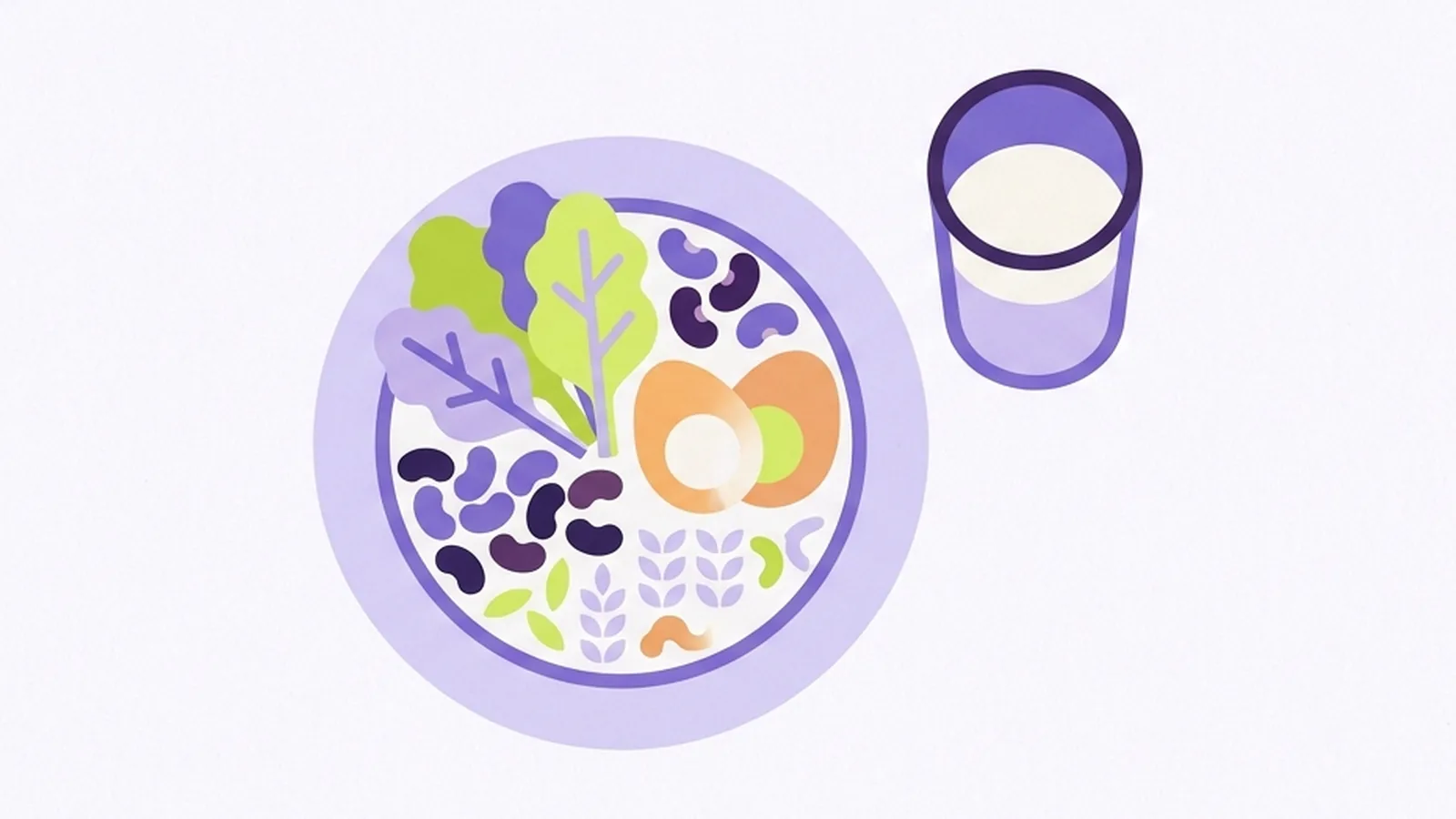
- GLP-1 medicines cut energy intake by 16–39% vs placebo, so a 2025 joint advisory says the priority is getting enough nutrients into less food: mostly minimally processed foods, enough protein, and fluids.1
- It suggests regular, small meals at consistent times and avoiding large or very fatty meals, which make nausea, vomiting and diarrhea more likely.1
- Protein targets of 1.2–1.6 g/kg a day, or 80–120 g a day, have been proposed during weight loss. No diet has been tested as "the" GLP-1 diet.1
Why food choices matter more on a GLP-1
Semaglutide (Ozempic, Wegovy) and tirzepatide (Zepbound, Mounjaro) work largely by making you eat less. Lab studies show how big that change is.
In a 20-week trial of 72 adults with obesity, people on semaglutide 2.4 mg ate 35% less at an all-you-want lunch than people on placebo.2 A newer 60-week trial of 120 adults with overweight or obesity found the gap held: the semaglutide group ate about 292, 240 and 270 kcal less at that lunch at weeks 20, 40 and 60, even though their appetite ratings no longer differed from placebo by weeks 40 and 60.3
Eating that much less is the point. The catch, according to the 2025 advisory from the American College of Lifestyle Medicine, the American Society for Nutrition, the Obesity Medicine Association and The Obesity Society, is that vitamins and minerals can fall short, especially below about 1,200 kcal a day for women and 1,800 kcal a day for men.1 Nutrients it names as a concern include iron, calcium, magnesium, zinc, and vitamins A, D, E, K, B1, B12 and C.
What to eat on a GLP-1: the advisory's list
The advisory does not prescribe a named diet. It gives a list of foods and habits to lean toward and to cut back on.1
| Encourage | Minimize or avoid |
|---|---|
| Fruits (berries, apples, citrus, bananas) | Refined carbohydrates (white flour, refined grains, added sugars) |
| Vegetables (leafy greens, broccoli, tomatoes, carrots) | Sugar-sweetened drinks |
| Whole grains (oats, quinoa, brown rice, whole-grain bread) | Red and processed meats |
| Dairy (yogurt, milk, cheese) | Most fast food |
| Lean proteins (poultry, fish, seafood) and eggs | Sweets and savory snacks |
| Nuts and seeds; olive, canola and avocado oils | |
| Ginger or peppermint tea |
Legumes such as beans and lentils also appear in the advisory's list of nutrient-dense foods to emphasize. An earlier 2024 review on nutrition with obesity medicines similarly says clinicians can counsel patients on protein, fiber, micronutrients and fluids before treatment starts.4
How should you eat? Meal patterns that help
| Do more of | Do less of |
|---|---|
| Regular, small meals at consistent times | Long gaps without food, getting overly hungry |
| Flexibility with food choices | Large meals |
| Portion-controlled treats | Emotional, mindless or nighttime eating |
| Adequate fluids | Alcohol (keep it minimal) |
The advisory notes that some people go many hours without eating because they simply are not hungry. That can leave nutrient gaps, or lead to cravings for sugary, refined foods once hunger finally hits. When appetite is very low, it suggests smoothies or protein drinks made with fruit, vegetables and unsweetened milk or yogurt, cottage cheese, or soup, which many people find easier than red meat or hard cheese. If that is not enough, an alarm or reminder to eat can help.1
Foods that can make side effects worse
Stomach side effects are most likely when you start or raise the dose. The advisory's food-related tips by symptom:1
- Nausea. Often worse in the morning or after long stretches without food. Smaller, more frequent meals help, as does avoiding fatty or high-fiber foods during the first few days of treatment. One approach: a small breakfast, then small meals every 3–4 hours with enough fluids.
- Vomiting. More likely after large meals.
- Constipation. Fluids and fiber from food are encouraged, with fiber increased gradually (prunes or other dried fruit, for example). High-protein and high-fat foods slow the stomach further and may need to be limited for a while.
- Diarrhea. Avoiding large or high-fat meals can help.
- Reflux and nausea. Alcohol may make both worse, and the advisory says it should be minimized. More in GLP-1 and alcohol.
How much protein, fiber and fluid?
Protein. The advisory says targets of 1.2–1.6 g per kg of body weight per day have been proposed during active weight loss, and that a flat 80–120 g a day may be easier to follow. It pairs this with strength training at least three times a week, because protein alone is likely not enough to protect muscle.1 We cover the details, and a calculator, in How much protein do you need on a GLP-1?
Fiber. The advisory encourages fiber from foods like whole grains, fruit, vegetables and legumes, increased gradually, but it does not set a gram target for GLP-1 users.1
Fluids. It says to ensure adequate fluids and to prevent dehydration, without giving a set volume. Eating less food also means less water from food.1
Supplements. It says supplements such as vitamin D, calcium, B12 or a multivitamin can be considered for at-risk nutrients, at appropriate doses and tailored to each person. It lists warning signs of deficiency: unusual fatigue, excessive hair loss, flaky or itchy skin, muscle weakness, poor wound healing and easy bruising. Which supplements, if any, is a question for your care team.1
What a day could look like
This is only an illustration of the advisory's principles, not a meal plan or a prescription. Portions depend on your appetite, your needs and your care team's advice.
| When | Example | Principle it shows |
|---|---|---|
| Morning | Greek yogurt with berries and a spoon of chia seeds; ginger tea | Small breakfast, dairy protein, fruit, seeds |
| Late morning | A boiled egg and an apple | Small meal every 3–4 hours |
| Lunch | Lentil and vegetable soup with a slice of whole-grain bread | Legumes, vegetables, whole grains |
| Afternoon | Smoothie with milk, banana and spinach | An easy option when appetite is low |
| Dinner | A small portion of baked fish, quinoa and roasted broccoli with olive oil | Lean protein, whole grain, vegetables, plant oil |
| Through the day | Water | Adequate fluids |
What the research cannot tell you yet
The advisory says the effect of specific diets or foods on how much weight people lose with GLP-1s still needs research. Its recommendations draw on the wider nutrition and obesity evidence plus clinical experience, not on trials comparing diets in people taking these medicines.1 The drug trials themselves paired the medicine with general advice: the Zepbound label, for example, says it is used with a reduced-calorie diet and increased physical activity.5 If you have kidney disease, diabetes treated with insulin or sulfonylureas, a history of eating disorders, or other conditions, ask your care team or a registered dietitian before changing how you eat.
Common questions
What should you eat on a GLP-1 like Ozempic, Wegovy or Zepbound?
A 2025 joint advisory from four US nutrition and obesity societies recommends a variety of minimally processed, nutrient-dense foods: fruits, vegetables, whole grains, legumes, dairy, lean proteins, eggs, nuts and seeds. For protein, it describes targets of 1.2–1.6 g per kg of body weight a day during active weight loss, or a simpler 80–120 g a day.
What foods should you avoid on a GLP-1?
The 2025 advisory lists refined carbohydrates, sugar-sweetened drinks, red and processed meats, most fast food, and sweets and savory snacks as foods to minimize. For side effects, it says large meals make vomiting more likely and that fatty meals can worsen nausea and diarrhea, especially in the first days of treatment and after dose increases.
How much less do people eat on semaglutide?
In a 20-week trial of 72 adults with obesity, people on semaglutide 2.4 mg ate 35% less at a self-serve lunch than people on placebo. In a 60-week trial of 120 adults, the semaglutide group was still eating about 270 kcal less at that lunch at week 60.
Do you need vitamins or supplements on a GLP-1?
The 2025 advisory warns that intake can fall short of vitamins and minerals, especially below about 1,200 kcal a day for women and 1,800 kcal a day for men. It says supplements such as vitamin D, calcium, B12 or a multivitamin can be considered, tailored to each person, which is a decision for your care team.
Is there a special diet plan for Zepbound or tirzepatide?
No diet has been tested specifically with tirzepatide (Zepbound, Mounjaro). The Zepbound label says it is used with a reduced-calorie diet and more physical activity, and the 2025 advisory's guidance covers GLP-1 medicines as a group, including tirzepatide.
Sources
- Mozaffarian D, Agarwal M, Aggarwal M, et al. Nutritional priorities to support GLP-1 therapy for obesity: A joint Advisory from the American College of Lifestyle Medicine, the American Society for Nutrition, the Obesity Medicine Association, and The Obesity Society. Obesity (Silver Spring). 2025;33(8):1475-1503. doi:10.1002/oby.24336 · Full text (PMC)
- Friedrichsen M, Breitschaft A, Tadayon S, et al. The effect of semaglutide 2.4 mg once weekly on energy intake, appetite, control of eating, and gastric emptying in adults with obesity. Diabetes Obes Metab. 2021;23(3):754-762. doi:10.1111/dom.14280 · Full text (PMC)
- Tronieri JS, Allison KC, DeRouen K, et al. Short- and long-term effects of semaglutide 2.4 mg on energy intake, appetite, and food reward: a 60-week, double-blind randomized controlled trial. Am J Clin Nutr. 2026;124(2):101403. doi:10.1016/j.ajcnut.2026.101403 · PubMed
- Almandoz JP, Wadden TA, Tewksbury C, et al. Nutritional considerations with antiobesity medications. Obesity (Silver Spring). 2024;32(9):1613-1631. doi:10.1002/oby.24067
- ZEPBOUND (tirzepatide) injection, US prescribing information, section 1 (Indications and Usage). DailyMed
