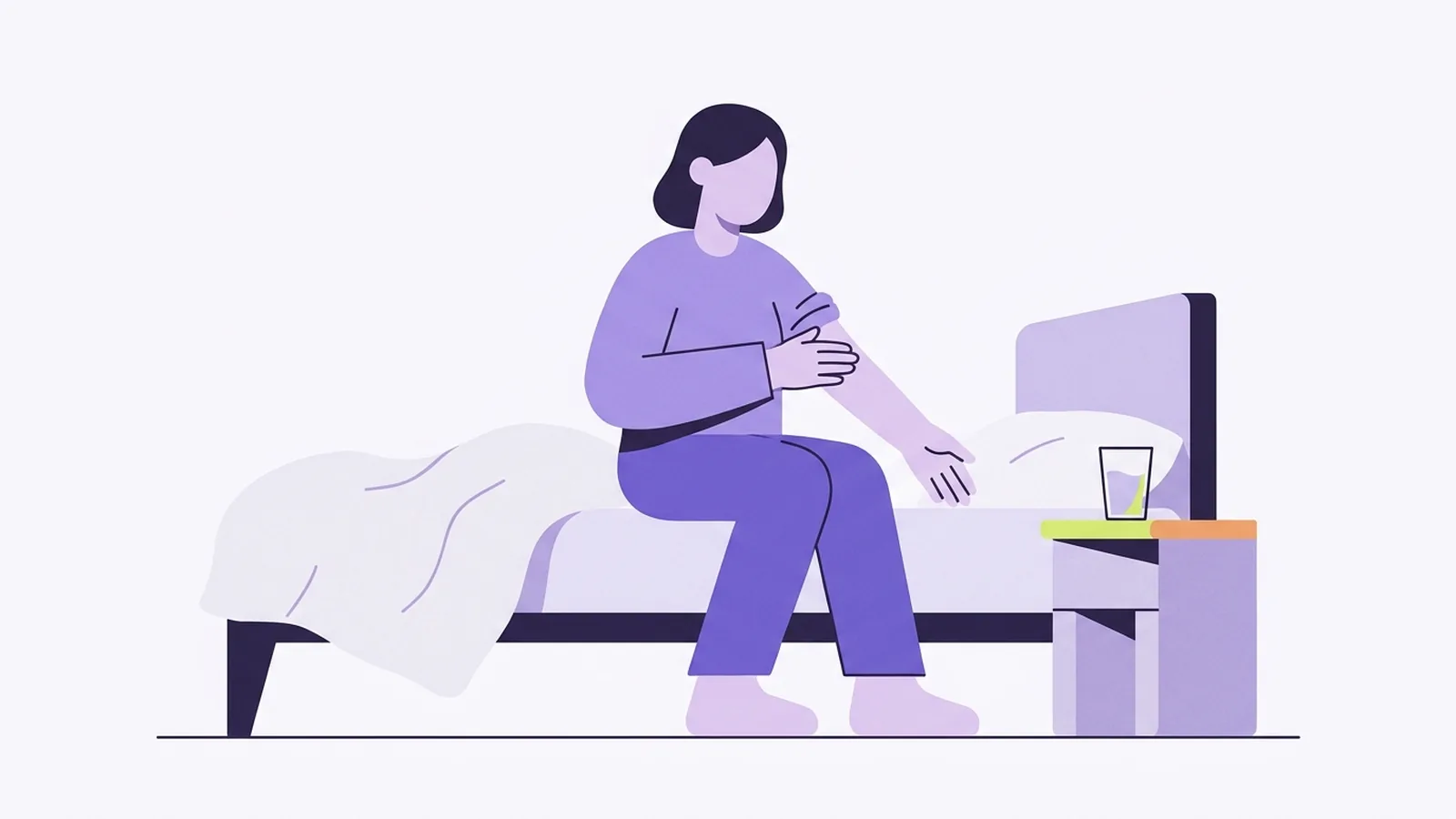
- Sore, tingly, burning or touch-sensitive skin on Wegovy has a label name: dysesthesia. The US label groups 11 related terms under it, including allodynia and hyperesthesia.1
- It is dose-related. In the label's 2.4 mg weight-loss trials it was 2% vs 1% on placebo. In the 7.2 mg trials it was 22% on 7.2 mg, 6% on 2.4 mg and 0.3% on placebo.1
- The tirzepatide labels list dysesthesia too, at under 1%.3,4 The cause is unknown. New skin symptoms are worth raising with your care team.
What the words mean
People describe this side effect in everyday words: skin that feels sunburned, prickly, raw or sore when clothes or sheets touch it. Doctors use a few overlapping terms:
- Dysesthesia: an unpleasant, abnormal skin sensation.
- Paresthesia: tingling or pins and needles.
- Hyperesthesia: skin that is more sensitive than usual.
- Allodynia: pain from a touch that would not normally hurt.
The Wegovy label does not count these one by one. It pools them. For the 7.2 mg trials, its "dysesthesia" row includes allodynia, burning sensation, dysesthesia, hyperesthesia, hyperpathia, pain of skin, paresthesia, sensitive skin, skin burning sensation, skin discomfort and skin sensitization.1 The patient Medication Guide lists it more simply as "changes in skin sensations" among the most common side effects.1
This is different from a reaction at the injection site. The sensation is not limited to where you inject. Injection site redness or lumps are covered in where to inject Ozempic, Wegovy or Zepbound.

How often it happened, by dose
The Wegovy label reports dysesthesia from three sets of trials in adults with obesity or overweight:1
| Trials (label) | Placebo | Wegovy |
|---|---|---|
| 2.4 mg injection, pooled weight-loss trials | 1% | 2% (2.4 mg) |
| 25 mg daily tablet, one trial in adults without diabetes | 0% | 5% |
| 7.2 mg trials, adults with and without type 2 diabetes | 0.3% | 6% (2.4 mg) · 22% (7.2 mg) |
Dysesthesia in the Wegovy 7.2 mg trials, pooled, as reported in the label.1
Split by trial, STEP UP enrolled adults with a BMI of 30 or more and no diabetes. Dysesthesia was reported by 22.9% on 7.2 mg, 6.0% on 2.4 mg and 0.5% on placebo.5 STEP UP T2D enrolled adults with obesity and type 2 diabetes: 18.9% on 7.2 mg, 4.9% on 2.4 mg and none on placebo.6 Both trials were funded by Novo Nordisk, which makes Wegovy. The label adds that dysesthesia became more common "with increasing dosage and drug levels in the blood."1
A separate Novo Nordisk-funded phase 2 trial in 245 adults with type 2 diabetes tested even higher weekly doses. Dysesthesia was reported by 18% on 16 mg and 8% on 8 mg, vs 0% on 2 mg and 2% on placebo. Of 19 cases, 11 were mild and 8 moderate.7
For what happened after dysesthesia started on 7.2 mg, including dose cuts, recovery and how often it came back on re-escalation, see Wegovy 7.2 mg: what the STEP UP trials found. In short, most people whose dose was lowered, paused or stopped recovered, and 18% did not report recovering during the trial.1
Do Ozempic, Zepbound or Mounjaro list it?
- Ozempic (semaglutide): lists dysesthesia under postmarketing reports, the section for side effects reported after approval. The label notes these reports are voluntary, so their frequency cannot be reliably estimated.2
- Zepbound (tirzepatide): in its two pooled weight-loss trials, dysesthesia was reported by 0.2% on 5 mg, 0.2% on 10 mg and 0.4% on 15 mg, vs 0.1% on placebo.3
- Mounjaro (tirzepatide): in its pooled placebo-controlled diabetes trials, 0.4% at each dose and none on placebo. In a heart outcomes trial, 0.7% of people on Mounjaro reported it.4
So the labels show the signal with both drugs, but the reported rates on tirzepatide are far lower than on high-dose semaglutide. The trials were run differently, so the numbers are not a head-to-head comparison.
What case reports and safety databases add
Case reports are small and cannot show how common something is. They do describe what it is like.
- Semaglutide 2.4 mg, four patients. A 2025 case series described allodynia that began with the 2.4 mg weekly dose in four people treated for obesity. Two stopped the drug and their symptoms resolved. Two continued, and one improved after 4 months. The authors found no mechanism.8
- Semaglutide and tirzepatide, two patients. A 2025 report described a sunburn-like feeling that lasted about six weeks on semaglutide 2.4 mg and went away on its own, and whole-body burning on tirzepatide 15 mg that resolved after it was stopped.9
- Tirzepatide, two patients. A 2026 case series described moderate to severe allodynia in two adults with obesity. It appeared during dose escalation and resolved after tirzepatide was stopped.10
A 2026 analysis by French pharmacovigilance researchers looked at the WHO global database of suspected side effect reports. Of 426,945 reports involving GLP-1 medicines, 4,281 (1.0%) involved dysesthesia or related terms, and about 70% came from consumers. Semaglutide and tirzepatide were both reported more often than expected for hyperesthesia, and semaglutide for dysesthesia.11 In 15 detailed French cases, mostly burning on the back, abdomen, thighs and arms, symptoms began 3 to 93 days after the first injection, and resolved after the drug was stopped. In 3 people who restarted, the same symptoms came back at the same dose.11 Report databases cannot give a true rate, and anyone can file a report.
What is unknown about the cause
No one knows why this happens. The phase 2 trial authors call the mechanism "still unknown."7 The French authors list ideas that have been raised, such as effects on sensory nerves, which carry GLP-1 and GIP receptors, or nutrient deficiencies tied to eating less. They note that the short time to onset and fast recovery after stopping do not fit the slow nerve damage that deficiencies usually cause.11 They also point out that, in STEP UP, the extra cases appeared soon after the step from 2.4 mg to 7.2 mg, which makes weight or fat loss an unlikely explanation on its own.11 None of these ideas has been tested.
What the data do support is a link to dose and drug level. To see how semaglutide levels rise and fall across the week, try the free GLP-1 level chart.
For the full list of common and rare side effects, see GLP-1 side effects.
Common questions
Why does my skin hurt to touch on Wegovy?
The US Wegovy label calls this dysesthesia, an altered skin sensation that can include tingling, burning, sensitive skin, pain of the skin and allodynia, which is pain from a touch that would not normally hurt. The label says it became more common at higher doses and higher drug levels in the blood. Why it happens is not known.
How common is skin sensitivity on Wegovy 2.4 mg?
In the label's pooled weight-loss trials of the 2.4 mg dose, dysesthesia was reported by 2% of people on Wegovy vs 1% on placebo. In the 7.2 mg trials it was 22% on 7.2 mg, 6% on 2.4 mg and 0.3% on placebo.
Does Zepbound or Mounjaro cause skin sensitivity?
Both US tirzepatide labels list dysesthesia, but at low rates. On Zepbound it was 0.2% to 0.4% by dose vs 0.1% on placebo. On Mounjaro it was 0.4% at each dose vs none on placebo, and 0.7% in a heart outcomes trial. A few case reports describe allodynia on tirzepatide.
Does Wegovy skin pain go away?
In the 7.2 mg trials, most people whose dose was lowered, paused or stopped recovered, and the label says symptoms resolved faster when an action was taken. 18% did not report recovering during the trial. Published case reports describe resolution after stopping and, in some cases, while staying on the drug. Any change to your dose is a decision for your prescriber.
Sources
- US prescribing information: WEGOVY (semaglutide) injection and tablets. DailyMed, revised 06/2026. Section 6.1 and Medication Guide.
- US prescribing information: OZEMPIC (semaglutide) injection. DailyMed, version of 06/2026. Section 6.2.
- US prescribing information: ZEPBOUND (tirzepatide) injection. DailyMed, revised 08/2026. Section 6.1.
- US prescribing information: MOUNJARO (tirzepatide) injection. DailyMed, version of 08/2026. Section 6.1.
- Wharton S, Freitas P, Hjelmesæth J, et al. Once-weekly semaglutide 7·2 mg in adults with obesity (STEP UP): a randomised, controlled, phase 3b trial. Lancet Diabetes Endocrinol. 2025;13(11):949-963. doi:10.1016/S2213-8587(25)00226-8 · PubMed
- Lingvay I, Bergenheim SJ, Buse JB, et al. Once-weekly semaglutide 7·2 mg in adults with obesity and type 2 diabetes (STEP UP T2D): a randomised, controlled, phase 3b trial. Lancet Diabetes Endocrinol. 2025;13(11):935-948. doi:10.1016/S2213-8587(25)00225-6 · PubMed
- Aroda VR, Jørgensen NB, Kumar B, et al. High-Dose Semaglutide (Up to 16 mg) in People With Type 2 Diabetes and Overweight or Obesity: A Randomized, Placebo-Controlled, Phase 2 Trial. Diabetes Care. 2025;48(6):905-913. doi:10.2337/dc24-2425 · Full text (PMC)
- Stark J, Klass MJ, Owen L. Allodynia (skin tenderness) associated with semaglutide: A case series. Am J Health Syst Pharm. 2025;82(9):e426-e430. doi:10.1093/ajhp/zxaf008 · PubMed
- Ahern S. Allodynia and Dysesthesia Associated With Semaglutide and Tirzepatide. Cureus. 2025;17(10):e94126. doi:10.7759/cureus.94126 · Full text (PMC)
- Chakrabarti MP, Han S, Campbell NM. Cutaneous Allodynia Associated With GLP-1RA Tirzepatide for Weight Management: A Case Series. Am J Case Rep. 2026;27:e952158. doi:10.12659/AJCR.952158 · Full text (PMC)
- Laroche ML, Géniaux H, Jardou M. Dysesthesia associated with GLP-1 agonist therapies: data-mining analysis and literature review. Eur J Clin Pharmacol. 2026;82(6):154. doi:10.1007/s00228-026-04079-7 · Full text (PMC)
Cite this article: Minh Truong. Why does my skin hurt to touch on Wegovy? What the research says about dysesthesia. GLP-1.app. Updated November 24, 2026. https://glp-1.app/glp-1-skin-sensitivity-dysesthesia/
