- Stomach pain is a common, listed side effect: 5.7–7.3% on Ozempic vs 4.6% on placebo in adults with type 2 diabetes, and 20% vs 10% on Wegovy 2.4 mg in adults with obesity or overweight.1,2
- Pain, nausea and vomiting bunch up while the dose is being raised. In the semaglutide STEP 1–3 trials, they peaked around week 20 and then fell.5
- Some pain is a warning sign. Severe pain that will not go away, pain with fever or yellow skin, vomiting you cannot stop, or a swollen belly with no stool or gas needs prompt medical care.1–4,9
Ozempic and Wegovy are both semaglutide. Mounjaro and Zepbound are both tirzepatide. Ozempic and Mounjaro are for type 2 diabetes; Wegovy and Zepbound for weight management and other uses. For a full list of side effects, see Ozempic, Wegovy and Zepbound side effects.
How common is stomach pain and throwing up on Ozempic, Wegovy, Zepbound and Mounjaro?
Section 6.1 of each US label lists side effects reported more often on the drug than on placebo. In the Wegovy and Zepbound labels, "abdominal pain" is a grouped term. For Wegovy it includes upper and lower belly pain, discomfort, tenderness and pain just below the breastbone.2
| Medicine (who was studied) | Abdominal pain | Vomiting | Severe stomach side effects |
|---|---|---|---|
| Ozempic 0.5–1 mg (adults with type 2 diabetes) | 5.7–7.3% vs 4.6% | 5–9.2% vs 2.3% | 0.4–0.8% vs 0% |
| Wegovy 2.4 mg (adults with obesity or overweight, 68 weeks) | 20% vs 10% | 24% vs 6% | 4.1% vs 0.9% |
| Zepbound 5–15 mg (adults with obesity or overweight, 72 weeks) | 9–10% vs 5% | 8–13% vs 2% | 1.7–3.1% vs 1% |
| Mounjaro 5–15 mg (adults with type 2 diabetes) | 5–6% vs 4% | 5–9% vs 2% | 0.4–1.3% vs 0.9% |
The labels warn that rates from different trials cannot be compared directly. The Ozempic and Mounjaro trials were in people with type 2 diabetes and used lower doses, which is part of why their numbers look smaller.
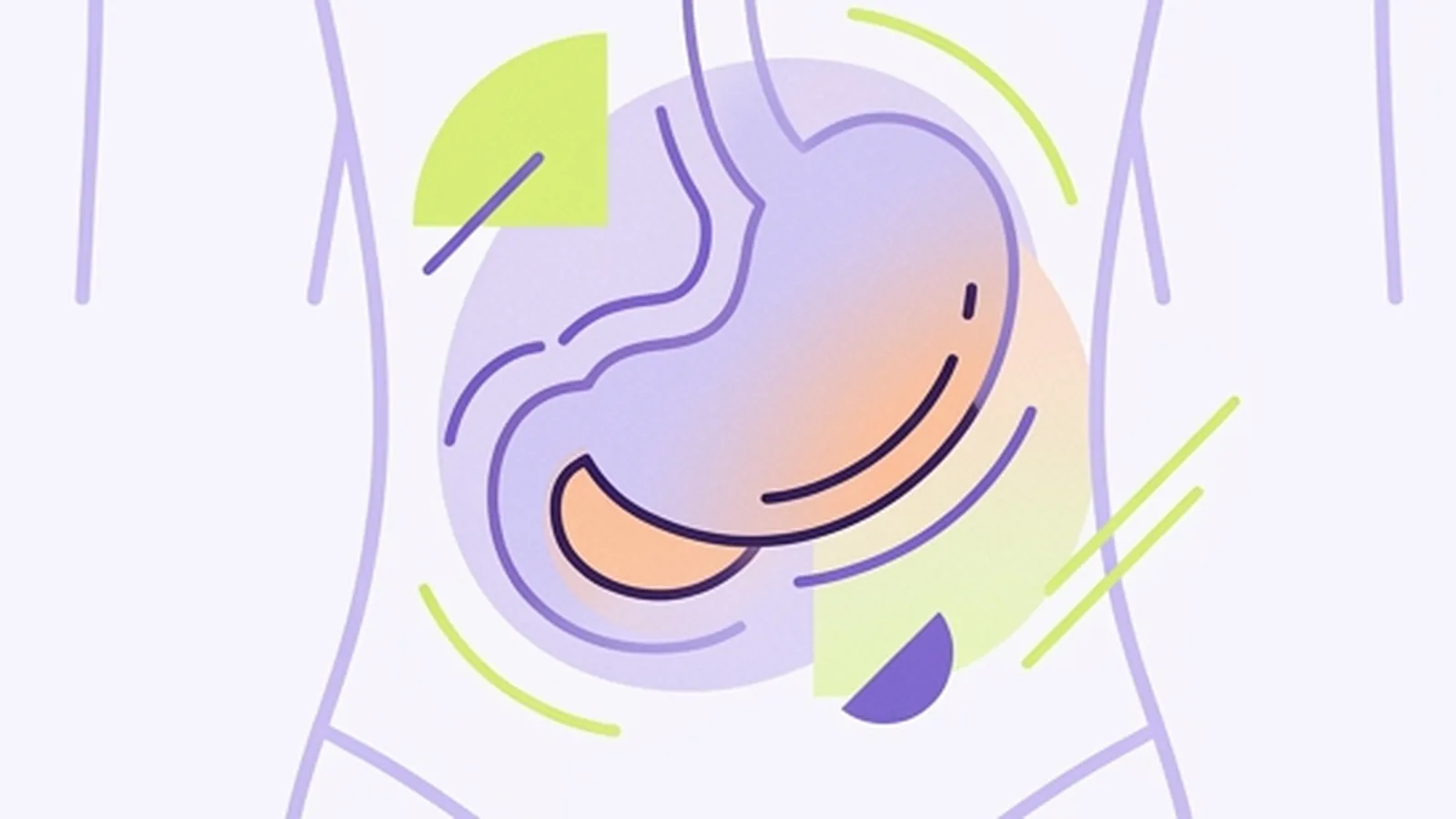
Why do GLP-1 medicines cause stomach pain?
- The stomach empties more slowly. Gastric emptying is how fast food moves from the stomach into the small intestine. All four labels say these medicines delay it. A full, slow stomach can feel heavy, sore or sick.1–4 See gastric emptying and GLP-1.
- Constipation. On Wegovy 2.4 mg, 24% reported constipation vs 11% on placebo. Cramping from hard or infrequent stools is a common source of lower belly pain.2 See GLP-1 constipation.
- Indigestion, bloating and gas. In the Wegovy weight-loss trials, indigestion (dyspepsia) was reported by 9% vs 3% on placebo, bloating (abdominal distension) by 7% vs 5%, gas (flatulence) by 6% vs 4%, reflux by 5% vs 3%, and gastritis (an irritated stomach lining) by 4% vs 1%. Zepbound showed the same pattern at lower rates, for example indigestion in 9–10% vs 4%.2,3 See diarrhea and sulfur burps.
Vomiting usually travels with nausea, which is covered in detail in GLP-1 nausea.
When does stomach pain on a GLP-1 peak?
Mostly during dose escalation, the weeks when the dose is stepped up. The Wegovy label says stomach side effects were most often reported then. The Ozempic, Zepbound and Mounjaro labels say most nausea, vomiting and diarrhea happened during escalation, and the Zepbound and Mounjaro labels add that they decreased over time.1–4
The best timing data come from a pooled analysis of the STEP 1, 2 and 3 trials: 2,117 adults with overweight or obesity on semaglutide 2.4 mg and 1,262 on placebo, for 68 weeks.5
Severe stomach side effects in that analysis were nausea, abdominal pain, diarrhea and vomiting. They were reported by 4.1% on semaglutide vs 0.9% on placebo.5 The Wegovy label says that if a dose step is not tolerated, prescribers can consider delaying the next increase by 4 weeks. That is the label's instruction to prescribers; any change to your dose is a decision for you and your care team.2
When is stomach pain on Ozempic or Zepbound a red flag?
The labels name four kinds of serious problem that can show up as stomach pain or vomiting. Their wording is summarized below. These are the labels' instructions, not advice for any one person.
| Symptom | What it may mean | What the label says to do |
|---|---|---|
| Severe stomach pain that will not go away, with or without vomiting; it may spread to the back | Acute pancreatitis (an inflamed pancreas) | Stop the medicine and call your healthcare provider right away (Medication Guide). Prescribers are told to stop it if pancreatitis is suspected (section 5). |
| Pain in the upper stomach, fever, yellow skin or eyes (jaundice), clay-colored stools | Gallbladder problems, such as gallstones or an inflamed gallbladder | Call your healthcare provider (Wegovy) or tell your provider right away (Ozempic, Zepbound, Mounjaro). Prescribers are told to order gallbladder tests and follow-up if suspected. |
| Nausea, vomiting or diarrhea that does not go away; signs of dehydration | Fluid loss that can lead to acute kidney injury, sometimes needing dialysis | Drink fluids and tell your healthcare provider right away. Prescribers are told to monitor kidney function. |
| Stomach problems that are severe or will not go away, including severe constipation | Severe stomach side effects; after approval, reports of ileus (the gut stops moving) and bowel blockage | Tell your healthcare provider. The medicines are not recommended in severe gastroparesis. |
How often these happen, from the trials:
- Gallbladder. Gallstones were reported by 1.6% of adults on Wegovy injection vs 0.7% on placebo, and gallbladder inflammation (cholecystitis) by 0.6% vs 0.2%. On Zepbound, cholecystitis was 0.7% vs 0.2%.2,3
- Pancreatitis. In two Zepbound weight-loss trials, 0.2% of people on tirzepatide had acute pancreatitis confirmed by an expert panel.3 For the full research picture, see GLP-1 gallbladder and pancreatitis risks.
- Ileus and bowel blockage. These appear in the post-approval reports section of all four labels. Such reports are voluntary, so their true frequency is unknown.1–4
The US National Library of Medicine describes pancreatitis pain as usually in the upper left or middle of the belly, constant and severe, and sometimes spreading to the back.7 It describes gallbladder pain as usually in the upper right or upper middle of the belly, often after a fatty meal, and sometimes spreading to the right shoulder blade.8 Signs of a blocked or stalled bowel include a swollen belly, cramping, vomiting and being unable to pass stool or gas.9 Signs of severe dehydration include passing little or no urine, dizziness, a racing heart and confusion.10
For milder, everyday discomfort, the guidance on smaller meals, fluids and fiber is in GLP-1 nausea and GLP-1 constipation. Talk to your prescriber before changing or skipping a dose.
Common questions
Is stomach pain a side effect of Ozempic?
Yes. In the placebo-controlled trials in the US Ozempic label, abdominal pain was reported by 7.3% of adults with type 2 diabetes on 0.5 mg and 5.7% on 1 mg, vs 4.6% on placebo. On Wegovy 2.4 mg, the higher-dose semaglutide used for weight loss, it was 20% vs 10% on placebo.
Is throwing up on Ozempic normal?
Vomiting is a listed common side effect: 5% on Ozempic 0.5 mg and 9.2% on 1 mg vs 2.3% on placebo in adults with type 2 diabetes, and 24% vs 6% on Wegovy 2.4 mg in adults with obesity or overweight. In the STEP 1 to 3 trials, a typical vomiting episode on semaglutide 2.4 mg lasted a median of 2 days. Vomiting that does not stop can cause dehydration, which the labels link to kidney injury.
Does Zepbound cause stomach pain?
In two 72-week trials of adults with obesity or overweight, abdominal pain was reported by 9% to 10% on Zepbound (tirzepatide) 5 to 15 mg vs 5% on placebo, according to the US label. Vomiting was 8% to 13% vs 2%.
When is stomach pain on Wegovy or Zepbound serious?
The US labels name severe stomach pain that will not go away, sometimes spreading to the back, as a possible sign of pancreatitis, and tell patients to stop the medicine and call their provider right away. Upper stomach pain with fever, yellow skin or eyes, or clay-colored stools can point to gallbladder problems, which were reported in 1.6% on Wegovy vs 0.7% on placebo (gallstones).
Why does semaglutide cause abdominal pain?
Semaglutide and tirzepatide slow how fast food leaves the stomach, and they commonly cause constipation, indigestion, bloating and gas. In the Wegovy weight-loss trials, indigestion was reported by 9% vs 3% on placebo and bloating by 7% vs 5%.
Sources
- OZEMPIC (semaglutide) injection, US prescribing information and Medication Guide, sections 5, 6.1, 6.2 and 17. DailyMed (June 2026 version, checked November 2026).
- WEGOVY (semaglutide) injection and tablets, US prescribing information and Medication Guide, sections 2, 5, 6.1, 6.2 and 17. DailyMed (June 2026 version, checked November 2026).
- ZEPBOUND (tirzepatide) injection, US prescribing information and Medication Guide, sections 5, 6.1, 6.2 and 17. DailyMed (August 2026 version, checked November 2026).
- MOUNJARO (tirzepatide) injection, US prescribing information and Medication Guide, sections 5, 6.1, 6.2 and 17. DailyMed (August 2026 version, checked November 2026).
- Wharton S, Calanna S, Davies M, et al. Gastrointestinal tolerability of once-weekly semaglutide 2.4 mg in adults with overweight or obesity, and the relationship between gastrointestinal adverse events and weight loss. Diabetes Obes Metab. 2022;24(1):94-105. doi:10.1111/dom.14551 · PubMed · Full text (PMC)
- MedlinePlus Medical Encyclopedia. Abdominal pain. US National Library of Medicine (accessed November 2026).
- MedlinePlus Medical Encyclopedia. Acute pancreatitis. US National Library of Medicine (accessed November 2026).
- MedlinePlus Medical Encyclopedia. Acute cholecystitis. US National Library of Medicine (accessed November 2026).
- MedlinePlus Medical Encyclopedia. Intestinal obstruction and Ileus. US National Library of Medicine (accessed November 2026).
- MedlinePlus Medical Encyclopedia. Dehydration. US National Library of Medicine (accessed November 2026).
Cite this article: Minh Truong. Ozempic stomach pain: how common is it, and when is it serious?. GLP-1.app. Updated November 8, 2026. https://glp-1.app/glp-1-stomach-pain/
