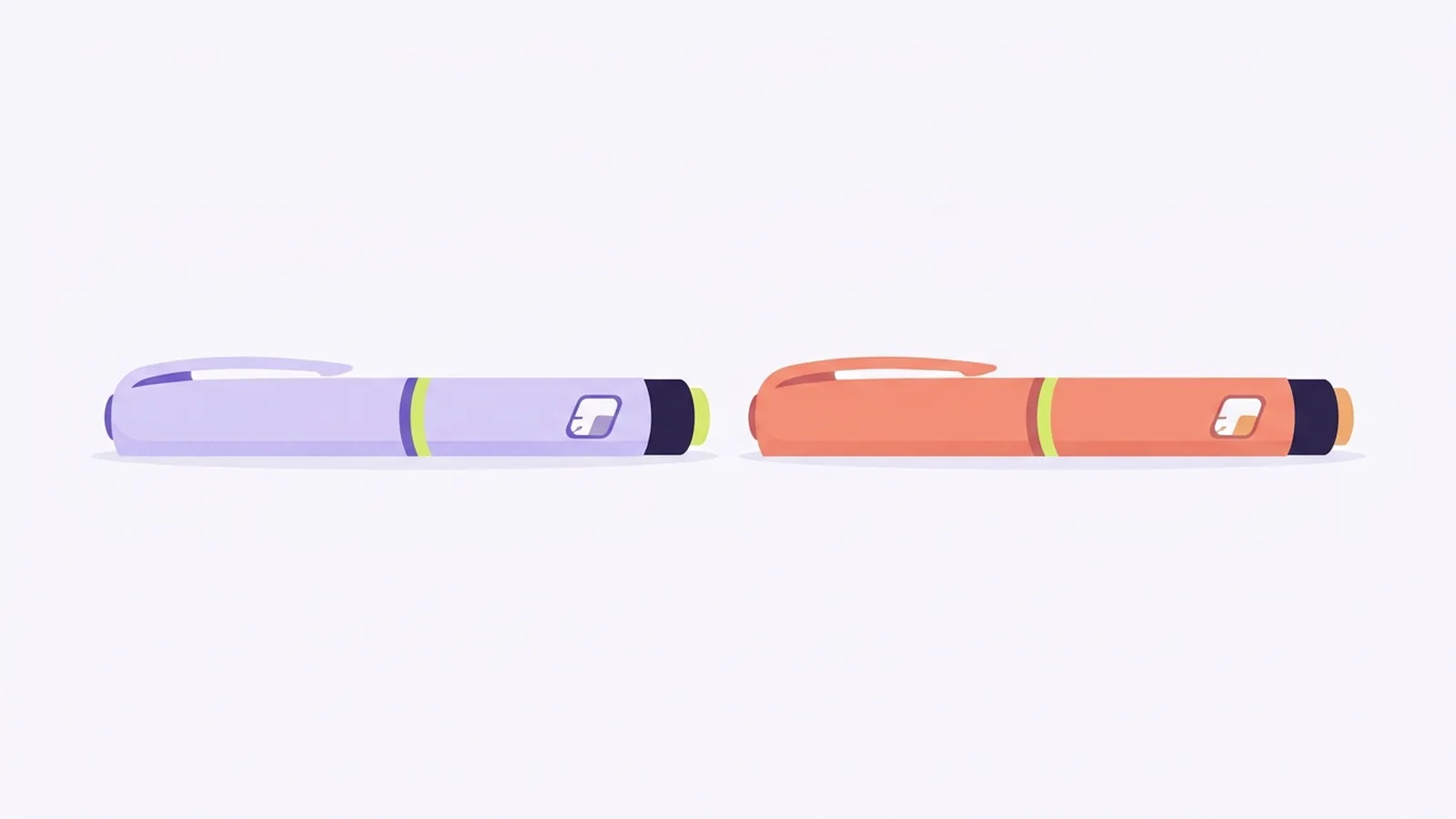
- In the one head-to-head trial, SURPASS-2, Mounjaro (tirzepatide) lowered blood sugar and weight more than Ozempic (semaglutide) 1 mg: up to 11.2 kg lost vs 5.7 kg over 40 weeks in adults with type 2 diabetes.1,2
- They are different medicines. Mounjaro acts on GIP and GLP-1 receptors; Ozempic acts on GLP-1 only. Stomach side effects were similar in the trial, but serious adverse events were reported more often on tirzepatide (5 to 7% vs 3%).1
- Both now carry a heart-risk approval. Only Ozempic is approved to lower kidney risk in type 2 diabetes with chronic kidney disease, as of November 2026.2,3
Mounjaro vs Ozempic at a glance
Mounjaro and Ozempic are both once-weekly injections for adults with type 2 diabetes, but Mounjaro contains tirzepatide and Ozempic contains semaglutide.
| Mounjaro | Ozempic | |
|---|---|---|
| Medicine and maker | Tirzepatide, Eli Lilly | Semaglutide, Novo Nordisk |
| How it works | GIP and GLP-1 receptor agonist | GLP-1 receptor agonist |
| Blood sugar (type 2 diabetes) | Adults and children 10 and older | Adults |
| Heart risk reduction | Adults with type 2 diabetes at high risk of heart attack, stroke or CV death (added August 2026) | Adults with type 2 diabetes and established cardiovascular disease |
| Kidney risk reduction | Not on the label | Adults with type 2 diabetes and chronic kidney disease |
| Label doses | 2.5 mg start, up in 2.5 mg steps; max 15 mg (10 mg in children) | 0.25 mg start, then 0.5, 1 or 2 mg; max 2 mg |
| Missed dose window | Within 4 days | Within 5 days |
| SURPASS-2 HbA1c drop, 40 weeks | 2.01 to 2.30 points (5 to 15 mg) | 1.86 points (1 mg) |
| SURPASS-2 weight change, 40 weeks | −7.6 to −11.2 kg | −5.7 kg |
| Self-pay price, as of Nov 9, 2026 | From $499 a month (single-dose pens) | $349 a month (0.25 to 1 mg); $499 (2 mg) |

Is Mounjaro the same as Ozempic?
No. The Mounjaro label describes tirzepatide as a GIP and GLP-1 receptor agonist, and the Ozempic label describes semaglutide as a GLP-1 receptor agonist only.2,3
Semaglutide is also sold as Wegovy, and tirzepatide as Zepbound, for weight management. For the four-brand overview, see Ozempic vs Wegovy vs Mounjaro vs Zepbound.
Is Mounjaro better than Ozempic? The SURPASS-2 trial
In SURPASS-2, all three tirzepatide doses lowered HbA1c more than semaglutide 1 mg over 40 weeks in 1,879 adults with type 2 diabetes: by 2.01, 2.24 and 2.30 percentage points on 5, 10 and 15 mg vs 1.86 on semaglutide.1 HbA1c is a three-month blood sugar average.
Everyone was already taking metformin. At the start, participants averaged 56.6 years old, 93.7 kg and an HbA1c of 8.28%. Tirzepatide was superior at every dose.1
| At week 40 | Semaglutide 1 mg | Tirzepatide 5 mg | Tirzepatide 10 mg | Tirzepatide 15 mg |
|---|---|---|---|---|
| HbA1c change (points) | −1.86 | −2.01 | −2.24 | −2.30 |
| Reached HbA1c under 7% | 79% | 82% | 86% | 86% |
| Weight change (kg) | −5.7 | −7.6 | −9.3 | −11.2 |
The trial compared tirzepatide with the 1 mg dose of Ozempic. The Ozempic label now goes up to 2 mg, which SURPASS-2 did not test, so the gap at the highest doses of each is not known from this trial.3
Mounjaro vs Ozempic for weight loss
In SURPASS-2, adults with type 2 diabetes lost an average of 7.6, 9.3 and 11.2 kg on tirzepatide 5, 10 and 15 mg, compared with 5.7 kg on semaglutide 1 mg, over 40 weeks.2 The extra loss with tirzepatide was 1.9, 3.6 and 5.5 kg.1
Neither is approved for weight management. People with type 2 diabetes tend to lose less weight on these medicines than people without it. See GLP-1 weight loss with type 2 diabetes.
Mounjaro vs Ozempic side effects
In SURPASS-2, stomach side effects were similar on both medicines and mostly mild to moderate: nausea affected 17 to 22% on tirzepatide and 18% on semaglutide 1 mg.1 Serious adverse events were reported in 5 to 7% on tirzepatide and 3% on semaglutide.
| SURPASS-2, 40 weeks | Tirzepatide 5 to 15 mg | Semaglutide 1 mg |
|---|---|---|
| Nausea | 17 to 22% | 18% |
| Diarrhea | 13 to 16% | 12% |
| Vomiting | 6 to 10% | 8% |
| Low blood sugar under 54 mg/dL | 0.6%, 0.2%, 1.7% | 0.4% |
| Serious adverse events | 5 to 7% | 3% |
Each label also pools its own placebo-controlled trials. The labels warn these rates cannot be compared directly across drugs.
- Mounjaro label (section 6.1): stomach side effects in 37.1%, 39.6% and 43.6% on 5, 10 and 15 mg vs 20.4% on placebo. 3.0%, 5.4% and 6.6% stopped treatment because of them, vs 0.4% on placebo.2
- Ozempic label (section 6.1): stomach side effects in 32.7% and 36.4% on 0.5 and 1 mg vs 15.3% on placebo. 3.1% and 3.8% stopped treatment because of them, vs 0.4% on placebo.3
Both labels say most stomach symptoms happened during dose increases. Both carry the same boxed warning about thyroid C-cell tumors in rodents.2,3 More detail: GLP-1 side effects and nausea and stomach side effects.
Key numbers
| Stat | Value | Population | Source |
|---|---|---|---|
| HbA1c drop, tirzepatide 15 mg vs semaglutide 1 mg | 2.30 vs 1.86 points | 1,879 adults with type 2 diabetes, 40 weeks | SURPASS-21 |
| Weight change, tirzepatide 15 mg vs semaglutide 1 mg | −11.2 vs −5.7 kg | Same | Mounjaro label, SURPASS-22 |
| Reached HbA1c under 7% | 86% vs 79% | Same | Mounjaro label, SURPASS-22 |
| Heart events, Ozempic vs placebo | 6.6% vs 8.9% (HR 0.74) | 3,297 adults with type 2 diabetes and CV disease, about 2 years | Ozempic label, SUSTAIN 63 |
| Kidney or CV death outcome, Ozempic vs placebo | 18.7% vs 23.2% (HR 0.76) | 3,533 adults with type 2 diabetes and CKD, median 41 months | Ozempic label, FLOW3 |
| Heart events, Mounjaro vs dulaglutide | HR 0.92 (noninferior) | Adults with type 2 diabetes and CV disease, median 210 weeks | Mounjaro label, SURPASS-CVOT2 |
What is each one approved for?
As of November 2026, both labels approve their medicine to improve blood sugar in type 2 diabetes and to lower the risk of heart attack, stroke and cardiovascular death in certain adults with type 2 diabetes. Only the Ozempic label adds kidney protection.2,3
- Ozempic heart use. In SUSTAIN 6 (Ozempic label, section 14), heart attack, stroke or cardiovascular death occurred in 6.6% on Ozempic vs 8.9% on placebo over a median of 2.1 years.3
- Ozempic kidney use. In FLOW, a major kidney event or cardiovascular death occurred in 18.7% on Ozempic 1 mg vs 23.2% on placebo over a median of 41 months. See semaglutide and kidney disease.3
- Mounjaro heart use. The Mounjaro label added this use in August 2026, based on SURPASS-CVOT. Tirzepatide was compared with dulaglutide (Trulicity), which already lowers heart risk, not placebo. It was noninferior (hazard ratio 0.92); the label states superiority was not established.2 Full results: tirzepatide and the heart (SURPASS-CVOT).
No trial has compared the two directly on heart or kidney outcomes.
How the dosing schedules compare
Both are injected once a week, at any time of day, with or without meals, and both start low and step up after at least 4 weeks per step, which the labels say is to reduce stomach side effects.2,3
The dose ranges and missed-dose windows are in the table at the top; for the Ozempic kidney use, the label's maintenance dose is 1 mg.3 These are the labels' instructions, not dosing advice. Full steps: tirzepatide dosage chart, semaglutide dosage chart and missed a GLP-1 dose.
Mounjaro vs Ozempic cost
As of November 9, 2026, Mounjaro self-pay through LillyDirect starts at $499 a month for every dose, and Ozempic self-pay through NovoCare is $349 a month for 0.25 to 1 mg and $499 for 2 mg.5,6
- Ozempic self-pay. NovoCare defines a month as 1 box with 1 pen. New self-pay patients pay $199 for each of their first 2 monthly fills of 0.25 mg or 0.5 mg, through December 31, 2026.5
- Mounjaro self-pay. Lilly lists single-dose prefilled pens at "starting at $499/month" for 2.5 mg to 15 mg, with a prescription; terms apply.6
- With commercial insurance. The Mounjaro savings card can bring the cost to as little as $25 if the plan covers it (savings up to $150 a month, $1,950 a year), or as low as $499 a month if it does not. The Ozempic card can bring it to as little as $25, with savings up to $100 a month. Both exclude government insurance, and the Mounjaro card terms end December 31, 2026.5,7
For the weight-loss brands, see how much Zepbound and Wegovy cost.
Wegovy vs Mounjaro
Wegovy is semaglutide at higher doses, approved for weight management; Mounjaro is tirzepatide approved for type 2 diabetes. The matching head-to-head weight trial is SURMOUNT-5, which compared tirzepatide (10 or 15 mg) with semaglutide at Wegovy doses (1.7 or 2.4 mg) in 751 adults with obesity and without diabetes: weight fell 20.2% vs 13.7% over 72 weeks.4
The Mounjaro label lists type 2 diabetes and heart-risk uses, not weight management.2 The waist, milestone and side-effect results from SURMOUNT-5 are in semaglutide vs tirzepatide.
What this comparison does not tell you
SURPASS-2 tested Ozempic 1 mg, not 2 mg, lasted 40 weeks, was open-label and was funded by Eli Lilly, which makes Mounjaro.1 Averages also hide wide variation between people. This article describes what a trial and the official labels say. It does not recommend one medicine over the other. Which one fits you depends on your health, how you tolerate a medicine and what you can access, a decision for you and your prescriber.
Common questions
Is Mounjaro the same as Ozempic?
No. Mounjaro is tirzepatide, made by Eli Lilly, and acts on two gut-hormone receptors, GIP and GLP-1. Ozempic is semaglutide, made by Novo Nordisk, and acts on the GLP-1 receptor only. Both are once-weekly injections approved in the US for adults with type 2 diabetes.
Is Mounjaro better than Ozempic?
In SURPASS-2, a 40-week trial of 1,879 adults with type 2 diabetes on metformin, tirzepatide 5, 10 and 15 mg lowered HbA1c by 2.01 to 2.30 percentage points vs 1.86 with semaglutide 1 mg, and all three doses were superior. The trial did not test the 2 mg Ozempic dose, and Ozempic has a kidney-outcome approval that Mounjaro does not.
Mounjaro vs Ozempic: which causes more weight loss?
In SURPASS-2, adults with type 2 diabetes lost 7.6, 9.3 and 11.2 kg on tirzepatide 5, 10 and 15 mg over 40 weeks, compared with 5.7 kg on semaglutide 1 mg. Neither Mounjaro nor Ozempic is FDA-approved for weight management.
Does Mounjaro have more side effects than Ozempic?
In SURPASS-2, stomach side effects were similar: nausea affected 17 to 22% on tirzepatide and 18% on semaglutide 1 mg, and vomiting 6 to 10% vs 8%. Serious adverse events were reported in 5 to 7% on tirzepatide and 3% on semaglutide.
Mounjaro vs Ozempic: which costs more without insurance?
As of November 9, 2026, Mounjaro self-pay pens on LillyDirect start at $499 a month at every dose. Ozempic self-pay on NovoCare is $349 a month for 0.25 to 1 mg and $499 for 2 mg, with $199 for a new patient's first 2 fills of the starting doses through December 31, 2026.
Sources
- Frías JP, Davies MJ, Rosenstock J, et al. Tirzepatide versus Semaglutide Once Weekly in Patients with Type 2 Diabetes (SURPASS-2). N Engl J Med. 2021;385(6):503-515. doi:10.1056/NEJMoa2107519 · PubMed
- MOUNJARO (tirzepatide) injection, US prescribing information, sections 1, 2, 6.1, 8 and 14. Eli Lilly and Company. DailyMed (version effective August 27, 2026, checked November 9, 2026).
- OZEMPIC (semaglutide) injection, US prescribing information, sections 1, 2, 6.1 and 14. Novo Nordisk. DailyMed (version effective June 1, 2026, checked November 9, 2026).
- Aronne LJ, Horn DB, le Roux CW, et al. Tirzepatide as Compared with Semaglutide for the Treatment of Obesity (SURMOUNT-5). N Engl J Med. 2025;393(1):26-36. doi:10.1056/NEJMoa2416394 · PubMed
- Novo Nordisk. Ozempic cost navigator and NovoCare Pharmacy Ozempic offer. Read November 9, 2026.
- Eli Lilly. Mounjaro on LillyDirect. Read November 9, 2026.
- Eli Lilly. Mounjaro Savings Card and resources. Read November 9, 2026.
Cite this article: Minh Truong. Mounjaro vs Ozempic: which works better for type 2 diabetes? What the trials found. GLP-1.app. Updated November 9, 2026. https://glp-1.app/mounjaro-vs-ozempic/
